
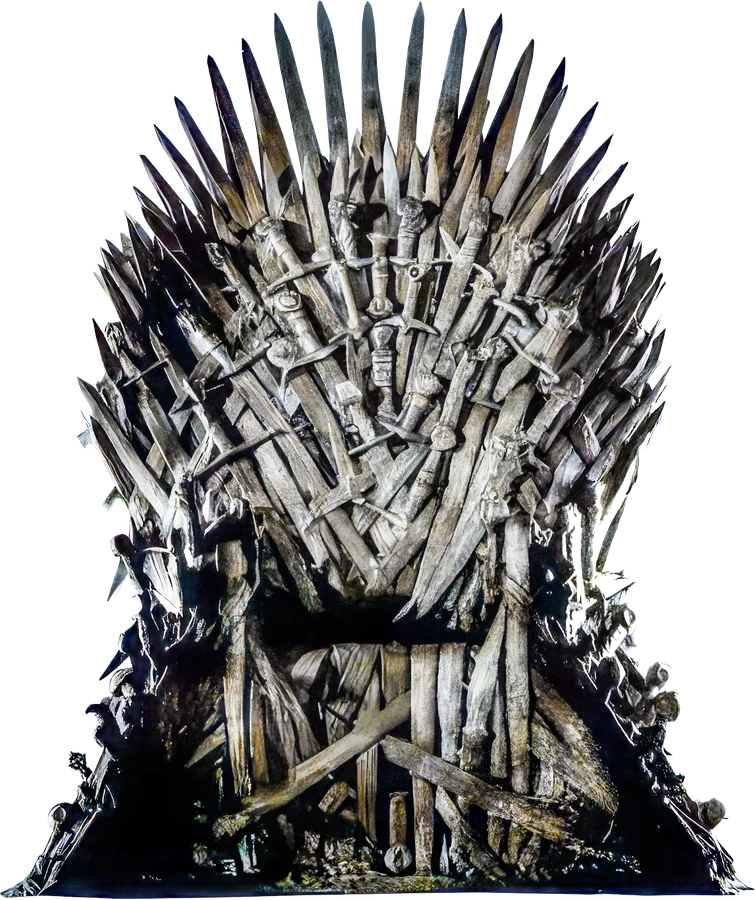
The Death of a King
It was not, in the end, an accident. Cersei — warned that Ned Stark had learned her secret — arranged for the king's squire, her cousin Lancel Lannister, to keep Robert's wineskin full of fortified strongwine on the hunt. Drunk beyond even his own considerable tolerance, Robert stood his ground against a huge boar and took its tusks in the belly even as he killed it. He was carried back to the Red Keep dying, ordered the boar served at his own funeral feast, and faced the end with more grace than he had faced most of his reign — mourning, at the last, the mess he was leaving and the friend he was leaving it to.
On his deathbed he dictated a will naming Eddard Stark Lord Protector and regent until his heir came of age. Ned, knowing Joffrey was no Baratheon, quietly wrote "my rightful heir" in place of the boy's name — an act of honesty that, in the snake pit of King's Landing, functioned as a death warrant for himself.
The War of the Five Kings was Robert's true bequest.
Every claimant traced a line to his crown
What He Left Behind
A contested crown
Because Robert's legal heirs were secretly none of his, his death opened every door at once. Joffrey took the throne as a Lannister cuckoo; Stannis proclaimed the truth and claimed the crown by right; Renly claimed it by charisma and a hundred thousand Reach swords; Robb Stark was raised up as King in the North after Joffrey took his father's head; and Balon Greyjoy, whom Robert had beaten once, crowned himself a second time. Five kings, one realm, and rivers of blood — all flowing from a marriage bed and a boar.
An empty treasury
Robert inherited a Crown flush with Targaryen gold and left it owing six million dragons — half to Casterly Rock, and the rest split between the Faith, Highgarden, the Iron Bank of Braavos, and Tyroshi money-changers. The debt bound the Iron Throne to Lannister money in life and haunted every government that followed him.
6,000,000
gold dragons owed at his death
- House Lannister3,000,000his own wife’s father
- The Faith1,000,000the gods, waiting to be paid
- House Tyrell1,000,000Highgarden, and its patience
- The Iron Bank & Tyroshi cartels1,000,000the Braavosi always collect
No war ran this up. Fifteen years of feasts, tourneys and never once asking what anything cost — and the interest never slept.
Grown by 0 since you started reading.
Fifteen years of peace
The fairest entry on the ledger. Whatever his failures, Robert's reign gave Westeros a long, prosperous peace between two cataclysms — long enough for a generation of knights to grow up never having swung a sword at anything but tourney rings. Even his critics conceded the realm ate well under the stag. It simply couldn't survive him.
The blood of the stag
The bitterest irony: the dynasty failed in the trueborn line and persisted in the baseborn one. Robert's bastards carried his unmistakable stamp — the black hair, the blue eyes, the strength — and it was precisely that resemblance, set beside three golden-haired "heirs," that let Jon Arryn, Stannis, and finally Ned Stark unravel the queen's secret. Robert's own blood, unacknowledged, was the proof that undid his house.
The Argument About Robert
Readers have been arguing about Robert Baratheon since 1996, which is exactly what a great character earns. The case against him is easy and largely true: a negligent king, a wretched husband, a man who laughed at the murder of children because they were dragonspawn, who drank a rich realm into debt and confused nostalgia for virtue.
The case for him is stranger and more interesting: he is the saga's great study in what victory costs. Robert got everything the songs promise — the war won, the villain slain in single combat, the crown, the beautiful queen — and the story simply kept going, into the part the songs omit. He knew it, too; his self-knowledge is what makes him tragic rather than merely failed. He was the best man in Westeros to win a throne and among the worst to sit one, and he would have told you both things himself, loudly, over the third cup of wine.
The hammer, the laugh, the ruin: ours is the fury, and his was too — with nowhere left to spend it.